 Binaural
Do binaural beats work?
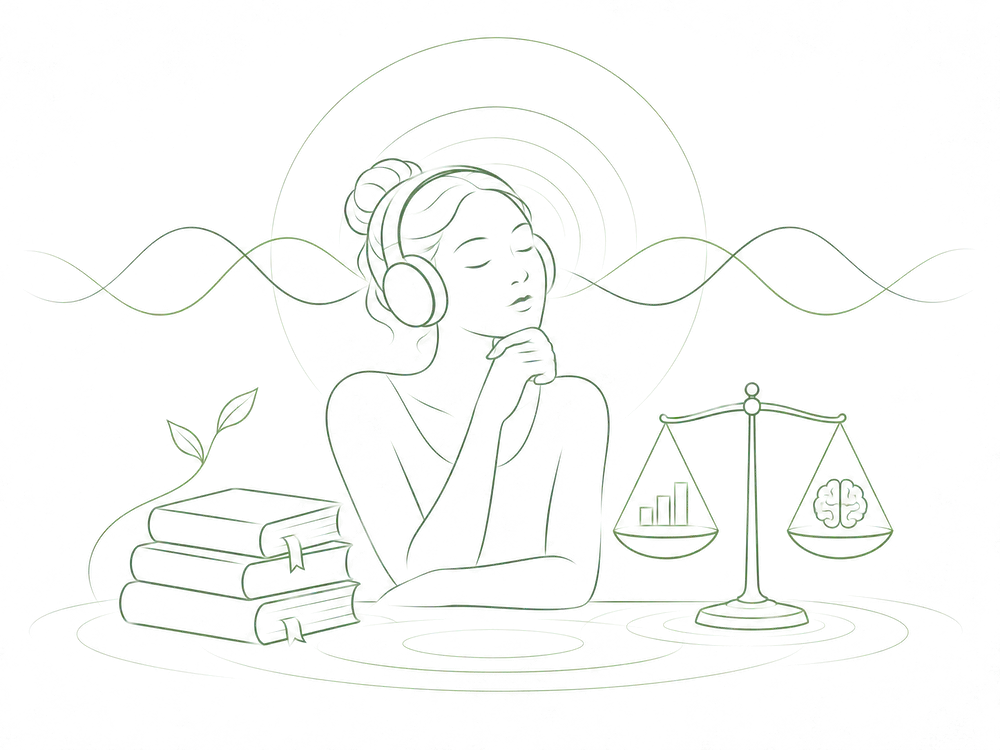
The honest answer is: sometimes, for some people, and the science is still young. Here is a fair summary.
What the evidence shows
A 2024 systematic review of 12 studies (Applied Sciences) found better results for anxiety and depression symptoms than control conditions. Other studies report small benefits for sleep quality and stress.
What it does not show
Samples are small, methods differ, and there is no agreed protocol. For focus and memory, results are mixed. Binaural beats are not a treatment for any condition.
Why people still use them
Many find a slow, steady sound with headphones helps them pause and relax. Part of the effect may be the ritual itself, and that is fine: a calm ten minutes a day is worth having.
How to judge for yourself
Try it daily for a couple of weeks, same time, low volume, and notice how you feel. That is how Binaural Rewire is designed: 21 short tracks, with Day 1 free.
Quick answers
Is there proof binaural beats work?
There is promising but limited evidence. Results vary.
Can they replace therapy?
No. They may support relaxation but do not replace professional care.
Try it yourself
Day 1 of the 21-day Binaural Rewire program is free. Headphones on, ten minutes. Sign up and you will also be the first to know when the full program opens.
More guides
- What are binaural beats?
- Binaural beats for sleep and winding down
- Binaural beats for focus and deep work
- Binaural beats for stress and anxiety
- Delta, theta, alpha and beta explained
- Binaural beats vs isochronic tones
- How long should you listen to binaural beats?
- Are binaural beats safe?
- Best headphones for binaural beats
- The 21-day binaural beats program
By Gonçalo, audio producer and sound designer in Lisbon. Last updated 2026-11-16. This page is general information, not medical advice.